September 16, 2026
Key Takeaways:
- Structural Degradation: Dead trees lose their internal tensile strength rapidly, making them unpredictable in high winds.
- Escalating Costs: Proactive removal is significantly less expensive than emergency storm response and property repair.
- Liability Exposure: Homeowners are legally responsible for damages caused by trees known to be hazardous.
- Pest Migration: Rotting wood serves as a primary attractant for wood-destroying insects like termites and carpenter ants.
- Impact on Neighbors: Dead trees pose a shared risk to adjacent properties, potentially damaging neighbor relations and insurance standing.
For many homeowners in Greater Milwaukee, a dead tree often goes unnoticed in the yard. It stands at the edge of the property like a bare skeleton, looking the same through the seasons. Many people assume that because it has survived storms, it must be strong. But a dead tree is far from stable. Once the tree’s system that carries water and nutrients stops working, the wood dries out and becomes brittle. Without moisture and flexibility, the tree can no longer bend with the wind, making it a potential danger.
Understanding the Physics of Tree Decay
In Southeast Wisconsin, our unique climatic cycles accelerate this breakdown. The persistent freeze-thaw cycles characteristic of Milwaukee winters are particularly destructive to dead timber. Moisture enters existing fissures in the bark and heartwood, expands as it freezes, and mechanically pries the wood fibers apart. By the time a homeowner notices external signs of decay, such as punky wood, falling bark, or fungal growth, the internal integrity of the trunk may already be compromised beyond the point of safety. Waiting for a dead tree to fall on its own is not a management strategy; it is a high-stakes gamble with your home’s safety.
a.) The Financial Implications of Proactive vs. Reactive Removal
One of the most compelling arguments for immediate action is the stark difference in cost. When a dead tree is addressed while it is still structurally sound enough to climb, an arborist can utilize controlled rigging and precision cutting to dismantle the tree safely and efficiently. This is a predictable, scheduled operation that allows for the most competitive pricing.
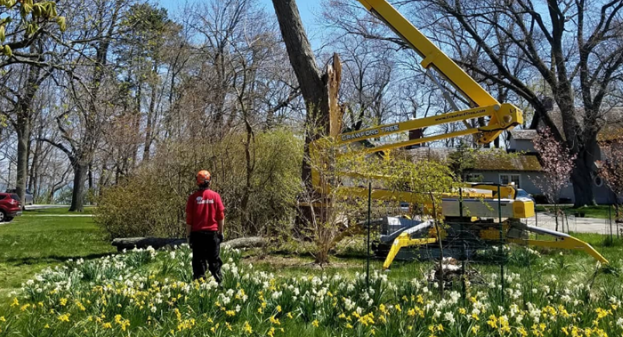
Conversely, reactive removal occurring after a tree has partially or completely failed is almost always an emergency scenario. Emergency removals often require specialized heavy equipment, such as large-scale cranes or bucket trucks, because the tree is no longer safe for a climber to ascend. Furthermore, if the tree has fallen onto a structure, a fence, or utility lines, the scope of work expands to include property restoration and potential insurance adjusters. In nearly every case, the invoice for an emergency call-out far exceeds the cost of a planned removal.
b.) Liability and the Legal Duty of Care
Property ownership in Wisconsin carries with it a specific duty of care. This legal principle dictates that a homeowner must take reasonable steps to prevent foreseeable harm to others. In the eyes of the law and insurance providers, a dead tree with visible signs of decay is considered a patent defect. If such a tree falls and damages a neighbor’s vehicle or, worse, causes a personal injury, the property owner may be found negligent.
Insurance companies are increasingly diligent in investigating tree-related claims. If an adjuster determines that the tree was dead for an extended period and the homeowner failed to mitigate the hazard, the claim for property damage could be denied. Proactively addressing a dead tree is not merely an aesthetic choice; it is a necessary step in protecting your financial assets and maintaining your standing as a responsible member of the community.
c.) Ecological Risks: Pests, Pathogens, and Property Health
A dead tree is rarely a solitary problem; it acts as a catalyst for broader ecological issues on your property. Rotting wood is a primary nesting site for carpenter ants and termites. While these insects play a role in forest decomposition, their presence in a residential yard provides a direct bridge to your home’s foundation and wooden structures. By allowing a dead tree to rot in place, you are essentially maintaining a high-capacity nursery for pests that can eventually migrate to your siding, deck, or structural framing.
Furthermore, if the tree died due to a communicable pathogen such as Oak Wilt or the Emerald Ash Borer leaving the wood on-site can facilitate the spread of the disease to healthy trees nearby. Removing the infected biomass and disposing of it according to local ordinances is a critical step in preserving the remaining canopy of your estate. A holistic approach to property management recognizes that the health of the turf and the safety of the structures depend on the removal of hazardous biological material.
d.) Preserving Curb Appeal and Real Estate Value
The aesthetic impact of a dead tree should not be underestimated. Mature trees are among the few landscaping features that increase in value over time, but a dead tree has the opposite effect. It signals a lack of maintenance and can significantly detract from the curb appeal of a Milwaukee estate. For homeowners considering a future sale, a hazardous tree is a major red flag during a home inspection, often resulting in last-minute price negotiations or demands for immediate removal before the closing.
Maintaining a clean, safe, and well-manicured landscape ensures that your property remains a source of pride rather than a source of anxiety. By replacing a hazardous tree with a healthy, site-appropriate species, you continue the cycle of growth and ensure that your property value remains protected for the next generation.
Why Professional Intervention is Mandatory
Attempting to remove a dead tree as a DIY project is one of the most dangerous tasks a homeowner can undertake. Dead wood is notoriously brittle and behaves unpredictably when cut. Unlike green wood, which has a degree of hinge strength, dead wood can snap-cut or shatter, leading to a loss of control over the direction of the fall. Professional arborists are trained in the physics of wood tension and utilize specialized safety gear to mitigate these risks.
Moreover, a professional assessment can often reveal if a tree is truly dead or if it can be saved through advanced soil treatments or structural cabling. A certified expert looks beyond the lack of leaves, examining the root flare, the trunk’s sound-resonance, and the presence of epicormic sprouting. This level of technical scrutiny ensures that you are only removing trees that are truly beyond recovery, while protecting those that contribute to the beauty of your Milwaukee landscape.
Crawford Tree & Landscape has been the trusted name in Greater Milwaukee for over half a century, providing an unmatched level of care for local estates since 1969. As a locally-owned company that has remained VC and PE-free, we prioritize long-term relationships and property health over quick profits. Our team is uniquely qualified, featuring a high concentration of ISA-Certified Arborists and NALP-Certified landscapers who bring formal education and specialized skills to every project.
When you need a professional tree removal firm in Milwaukee, WI for tree removal, look no further. Call Crawford tree & landscape. Our experts are supported by a Board Certified Master Arborist which ensures your property receives the highest standard of care. We are available 24/7 to handle everything from seasonal maintenance to emergencies, treating your landscape as if it were our own.
Frequently Asked Questions by the Homeowners in Milwaukee
How can I determine if a tree is dormant or truly dead in Milwaukee?
The scratch test is a reliable initial indicator. Use a small blade to gently remove a sliver of bark from several twigs. If the underlying tissue is green and moist, the tree is alive. If the tissue is brown and brittle across multiple locations, the tree has likely failed.
Can a dead tree be left as a wildlife snag?
While dead trees can provide habitat for woodpeckers and owls, this is only appropriate in large, wooded areas far from structures, power lines, and footpaths. In a residential Milwaukee setting, the risks of structural failure usually outweigh the ecological benefits.
What is the fall zone of a dead tree?
A tree’s fall zone is typically estimated as 1.5 times its total height. If any structure, driveway, or neighboring property falls within this radius, a dead tree should be considered a high-priority hazard that requires professional removal.
Why does the price of removal increase as the tree gets older?
As wood decays, it becomes unsafe for arborists to climb. This necessitates the use of heavy machinery like cranes or bucket trucks, which increases the operational costs and the amount of labor required to finish the job safely.
Will a dead tree eventually fall on its own?
Yes, every dead tree will eventually fall. The variable is the timing and the direction. Without intervention, the tree will fail during a moment of peak stress, usually a high-wind event or a heavy snow load which is exactly when emergency services are most strained.
What are the signs of internal trunk rot?
Key indicators include the presence of shelf-like mushrooms (conks) at the base, large cavities or holes in the trunk, and seeping areas where liquid is oozing from the bark. These all suggest that the core of the tree is hollow or decaying.
Should I remove the stump at the same time as the tree?
While not strictly required for safety, stump grinding is recommended. A dead stump continues to attract pests like termites and can be a tripping hazard or an obstacle for lawn maintenance equipment.
Summary Checklist: When to Call for Removal
| Condition | Risk Level | Recommended Action |
| Sudden Leaning | Critical | Call for emergency assessment immediately |
| Large Trunk Cracks | High | Schedule a professional inspection right away |
| Mushrooms or Fungus at the Base | Moderate to High | Inspect for internal decay and structural weakness |
| Dead or Bare Branches | Varies | Consult an arborist to determine if pruning or removal is needed |
| Overhanging Power Lines | High | Contact a licensed tree service for safe clearance |
Final Advice
If you notice any of these warning signs, do not wait for a storm to force the issue. A professional assessment from an arborist can determine if the tree can be saved through specialized care or dead tree removal is required to protect your property. The physics of decaying wood is unforgiving, and a tree that appears stable today can become a catastrophic liability tomorrow. By acting proactively, you avoid the immense stress and financial burden associated with emergency removals and structural repairs.
Furthermore, removing dead timber protects your surrounding landscape from pest infestations and the spread of pathogens that could endanger your healthy canopy. Responsible property management is about more than just aesthetics; it is about ensuring the safety of your family, your neighbors, and your investment. In the Greater Milwaukee area, where weather patterns can shift violently within hours, having a clear plan for hazardous tree management is essential.
Hiring an experienced tree service firm in Milwaukee, WI will ensure the work is handled with the precision and safety equipment required for brittle, dead wood. Whether you are dealing with a single hazard or a larger estate clearance, professional guidance provides the peace of mind that your landscape is resilient and secure. Take the time to inspect your trees today so you aren’t forced to manage a disaster tomorrow. Consistency, patience, and professional guidance are the keys to a green, thriving sanctuary that you can be proud of for years to come. If you want a dead tree to be removed from your lawn, contact Crawford Tree & Landscape immediately



 GreenSky® and GreenSky Patient Solutions® are loan program names for certain consumer credit plans extended by participating lenders to borrowers for the purchase of goods and/or services from participating merchants/providers. Participating lenders are federally insured, federal and state chartered financial institutions providing credit without regart to age, race, color, religion, national origin, gener or familial status. GreenSky® and GreenSky Patient Solutions® are registered trademarks of GreenSky, LLC. GreenSky Serviceing, LLC services the loans on behalf of participating lenders. NMLS 1416362. GreenSky, LLC and GreenSky Servicing, LLC are subsidiaries of Goldman Sachs Bank USA. Loans originated by Goldman Sachs are issued by Goldman Sachs Bank USA, Salt Lake City Branch.