September 18, 2026
Key Takeaways
- A tree rarely becomes unsafe overnight. Most hazards develop gradually and leave visible clues along the way.
- New leaning, especially after a storm, is one of the clearest signs a tree’s root system may be compromised.
- Fungal growth at the base of a trunk often indicates internal decay that isn’t visible from the outside.
- Cracks, cavities, and co-dominant stems with included bark all weaken a tree’s structural integrity in different ways.
- Location matters as much as the defect itself. The same crack or lean can carry very different levels of risk depending on what’s nearby.
- When in doubt, a professional risk assessment is the most reliable way to know whether a tree needs monitoring, treatment, or removal.
A tree doesn’t usually become dangerous all at once. In almost every case, the warning signs were present for months or even years before a limb failed or a trunk gave way. The challenge for most homeowners is knowing what to actually look for, since many of these signs are easy to dismiss as normal aging, weather-related shedding, or simply not obvious unless you know what you’re looking at. A tree that looks the same to the eye every time you walk past it can, in reality, be losing structural integrity steadily beneath the bark or below the soil line.
This is exactly the gap Crawford Tree & Landscape’s ISA-Certified Arborists are trained to close. Below is a closer look at the signs we watch for most closely when assessing whether a tree on a Milwaukee-area property has become a genuine safety concern, along with why each one matters and what tends to make it worse.
A New or Worsening Lean
Some trees naturally grow with a slight lean their entire lives, often the result of competing for light early in their development, reaching around a neighboring structure, or simply responding to prevailing wind patterns over decades of growth. That kind of long-standing, stable lean isn’t automatically a red flag, and plenty of healthy, mature trees carry one without any real cause for concern.
What matters far more is a new lean, or an existing lean that’s visibly gotten worse, particularly if it appeared suddenly after a storm or a period of saturated soil. A new lean often indicates the root plate has shifted or partially failed, which means the tree’s anchoring system is compromised even if the canopy above still looks perfectly healthy. This is one of the more urgent signs on this list, since a tree with a recently shifted root system can fail with very little additional stress, sometimes during a much lighter wind event than the one that caused the initial shift. It’s also worth paying attention to the soil around the base of a leaning tree. If the ground on the side opposite the lean looks cracked, lifted, or disturbed, that’s often a sign the roots are actively pulling loose from the soil rather than the tree simply growing at an angle it has held for years.
Cracks and Splits in the Trunk
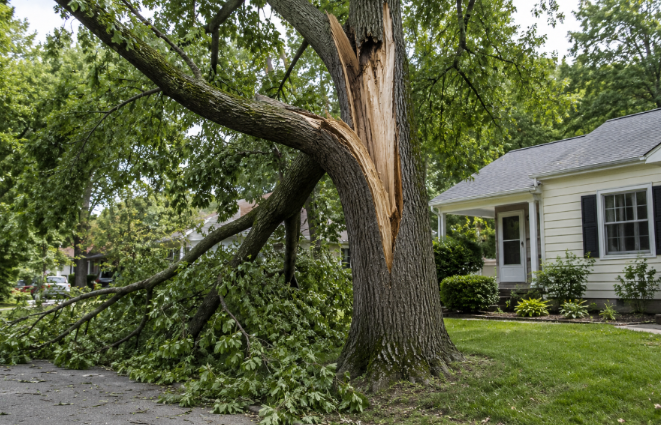
Vertical cracks running along a trunk, particularly ones that extend deep into the wood rather than sitting only in the outer bark, indicate the tree’s structural wood fibers have already separated to some degree. Not every crack is an emergency, but certain characteristics raise the level of concern considerably. Cracks that open and close slightly with wind movement, or that show fresh, lighter-colored wood inside rather than weathered, darkened wood, suggest active, ongoing movement rather than old, stable damage that the tree has already compartmentalized.
Location matters here as much as the crack itself. A crack near a major branch union or low on the trunk carries more risk than one higher up or farther from the base, since it affects a much larger portion of the tree’s structural support and the overall weight the compromised section has to bear. A crack that runs along the same line as a co-dominant stem union is a particularly important one to have evaluated, since it often signals that the union itself is beginning to fail.
Fungal Conks and Mushrooms at the Base
Mushroom-like growths, sometimes called conks, at the base of a trunk or along exposed roots are one of the more reliable outward signs of internal decay, since the fungi responsible for this kind of growth are typically breaking down wood fibers well before any external growth becomes visible above the soil or bark surface. By the time conks actually appear, decay has often been progressing internally for a considerable period, sometimes years.
This doesn’t automatically mean a tree needs to come down. Some trees can carry a degree of internal decay for years without failing, particularly if the decay is limited to a small portion of the trunk and the tree is otherwise structurally sound and vigorous. Trees have a natural ability to compartmentalize decay and continue adding sound wood around a damaged area. But the presence of conks does mean that there is a need to hire a dedicated tree service firm in Milwaukee, WI to perform a comprehensive tree assessment to determine
a.) how much sound wood actually remains
b.) where the decay is located relative to the tree’s overall structure, and
c.) whether that remaining wood is enough to safely support the canopy under normal wind and weather conditions.
Dead or Hanging Limbs
Deadwood in the canopy, branches that have no leaves during the growing season, brittle bark, or bark that’s visibly sloughing off, are common and often entirely manageable through routine pruning. Nearly every mature tree carries some amount of deadwood, and its presence alone isn’t necessarily cause for alarm. Hanging limbs that are broken but still partially attached are a different matter and represent a more immediate concern, since they can fail without warning and often retain enough weight to cause real damage to a roof, vehicle, or person if they come down unexpectedly.
A tree carrying a significant amount of deadwood throughout the canopy, rather than just a branch or two, can also indicate a broader health issue affecting the tree’s overall vigor, whether that’s root stress, disease, or a declining vascular system. In these cases, it’s worth investigating the underlying cause alongside the immediate hazard the dead limbs themselves present, since addressing only the visible hazard without understanding what’s driving the decline may only be a temporary fix.
Co-Dominant Stems and Included Bark
When a tree develops two or more stems of similar size growing from roughly the same point on the trunk, rather than one clearly dominant leader with smaller lateral branches, the union between those stems is often structurally weaker than a typical branch attachment. This is especially true when included bark, bark tissue that’s become trapped between the two stems as they grew together rather than forming a solid wood-to-wood connection, is present, since it prevents the union from developing the strength it would otherwise have.
These unions can fail under wind load or the added weight of ice or wet snow, and because the individual stems often look completely healthy on their own, this particular risk is easy to overlook unless someone is specifically examining how the branches are attached to each other rather than just how each one looks individually. This is one of the more common structural issues we find on mature shade trees throughout Milwaukee-area yards, particularly on species that naturally tend toward multiple co-dominant stems if not corrected through pruning at a younger age.
Soil Heaving and Root Damage
Cracked or lifted soil around the base of a tree, particularly on the side opposite a recent lean, can indicate the root plate is beginning to shift, sometimes gradually and sometimes as the result of a single significant wind or saturation event. Similarly, visible root damage from construction, trenching, grade changes, or heavy equipment operating too close to a tree’s root zone can compromise its stability even if the canopy shows no outward signs of stress for a year or more afterwards.
Root damage is one of the more deceptive hazards on this list precisely because of that delay. A tree can appear entirely normal above ground for a full growing season or longer after a significant root injury, which makes it easy to assume the tree came through unaffected when in fact the structural consequences simply haven’t caught up with the canopy yet.
Trusting a Professional Assessment
Many of these signs can look similar to an untrained eye but mean very different things depending on the specific tree, its species, its age, its history, and its surroundings. This is really the core value of a professional risk assessment: distinguishing between a cosmetic issue that can simply be monitored over time and a genuine structural hazard that needs prompt attention, whether that’s corrective pruning, cabling, or in more advanced cases, removal.
Crawford Tree & Landscape employs ISA-Certified Arborists who specialize in tree risk assessment. Our TCIA accreditation demonstrates our commitment to safety-focused, industry-standard evaluation practices. For over a half-a-century, Crawford Tree & Landscape has delivered professional tree care throughout Southeast Wisconsin. Our team also includes NALP-certified landscape professionals who help maintain the health of your property’s overall landscape while supporting our comprehensive tree care services.
If you’ve noticed a new lean, cracking, fungal growth, or hanging limbs on a tree near your home, driveway, or a space where people spend time, it’s worth having it assessed by someone trained to evaluate the risk rather than waiting to see how it develops. Crawford Tree & Landscape serves homeowners throughout Milwaukee, Brookfield, Germantown, Menomonee Falls, Mequon, Pewaukee, Waukesha, and Wauwatosa. Call our team at (414) 710-0093 to Book Your Free Estimate !!
Frequently Asked Questions
Does a tree with a lean always need to come down?
Not necessarily. A long-standing, stable lean is different from a new or worsening one. What matters most is whether the lean is recent or progressing, which usually points to root or soil movement rather than the tree’s natural growth habit.
Are mushrooms growing near a tree always a bad sign?
Fungal conks specifically attached to the trunk or exposed roots typically indicate internal decay, but not all fungi growing near a tree are connected to the tree’s health. A professional can identify what’s actually growing and whether it’s a genuine concern.
Can a tree with dead branches still be healthy overall?
Yes, a limited amount of deadwood is common and often manageable with routine pruning. It becomes more concerning when deadwood is extensive throughout the canopy, which can point to a broader underlying health issue rather than isolated branch decline.
What should I do if I notice a crack in my tree’s trunk?
Avoid spending time directly beneath the affected limb or trunk section and have the tree assessed as soon as possible, since active cracks can indicate ongoing structural movement rather than old, stable damage.
How often should mature trees near my home be checked for safety?
Most mature trees benefit from a professional look every one to two years, with more frequent checks recommended for trees showing any of the warning signs described above or located near structures, driveways, or power lines.
Why does the location of a defect matter as much as the defect itself?
A crack, lean, or weak union located near a home, driveway, or area where people regularly spend time carries far more real-world risk than the same defect on a tree in an open part of the yard, which is part of why a professional assessment weighs both the condition of the tree and what’s around it.
Summary Checklist: Signs a Tree May Be Unsafe
| Warning Sign | What It May Indicate | Level of Concern |
| New or worsening lean | Root plate shift or failure | High |
| Deep vertical trunk cracks | Structural wood separation | High |
| Fungal conks at the base | Internal decay | Moderate to High |
| Hanging or broken limbs | Immediate fall hazard | High |
| Co-dominant stems with included bark | Weak branch union | Moderate |
| Soil heaving near the base | Root plate movement | High |
| Extensive canopy deadwood | Broader decline or stress | Moderate |
Final Advice
Trees rarely fail without warning. A new lean, deep trunk crack, fungal conks, hanging limbs, or shifting soil all deserve prompt attention. Don’t assume these changes are part of normal ageing, especially if the tree is close to your home, driveway, or other high-use areas. Early evaluation can often identify whether the tree simply needs monitoring, corrective pruning, structural support, or removal before the risk increases. Regular inspections are especially valuable after severe storms or for mature trees that haven’t been assessed in several years.
Crawford Tree & Landscape’s ISA-Certified Arborists perform professional tree risk assessments using industry-recognized standards to identify structural concerns before they become safety hazards. If you’ve noticed any of these warning signs, schedule an assessment to protect your property and the people around it. Call Crawford Tree & Landscape at (414) 710-0093 to request your free estimate.
Reviewed by a Certified Arborist
This article was reviewed by a certified arborist to ensure the tree risk information reflects current arboricultural practices and industry standards.


 GreenSky® and GreenSky Patient Solutions® are loan program names for certain consumer credit plans extended by participating lenders to borrowers for the purchase of goods and/or services from participating merchants/providers. Participating lenders are federally insured, federal and state chartered financial institutions providing credit without regart to age, race, color, religion, national origin, gener or familial status. GreenSky® and GreenSky Patient Solutions® are registered trademarks of GreenSky, LLC. GreenSky Serviceing, LLC services the loans on behalf of participating lenders. NMLS 1416362. GreenSky, LLC and GreenSky Servicing, LLC are subsidiaries of Goldman Sachs Bank USA. Loans originated by Goldman Sachs are issued by Goldman Sachs Bank USA, Salt Lake City Branch.