In Milwaukee, WI, ash trees were once a dominant part of neighborhoods like Bay View, Wauwatosa, Shorewood, and West Allis. Unfortunately, many of those mature ash trees are disappearing due to a small but devastating invasive insect: the Emerald Ash Borer (EAB).
Homeowners often don’t realize their ash tree is infested until it’s already dying. By the time visible damage appears, the tree may already be structurally compromised. Knowing what to look for can mean the difference between saving your tree and needing emergency removal after the next storm.
Key Takeaways
- Early Detection Matters: Ash trees can often be treated if caught early.
- Canopy Decline Is a Red Flag: Thinning leaves usually mean internal damage is already underway.
- Structural Failure Risk: Dead ash trees become brittle and dangerous very quickly.
- Milwaukee is a Hot Zone: EAB is widespread throughout Milwaukee County and the surrounding areas.
1. Thinning or Dying Canopy (Top-Down Decline)
One of the earliest and most overlooked signs of Emerald Ash Borer infestation is canopy dieback, especially at the top of the tree.
In Milwaukee neighborhoods like Shorewood and Whitefish Bay, homeowners often notice:
- Sparse leaves at the top of the ash tree
- Smaller-than-normal leaves
- Entire branches failing to leaf out in spring
This happens because EAB larvae feed under the bark, destroying the vascular system that moves water and nutrients upward. The top of the tree is the farthest from the roots, so it’s the first area to starve. According to the Wisconsin DNR, this thinning is one of the most reliable visual indicators that a tree’s nutrient flow has been compromised.
If more than 30–40% of the canopy is thinning, the tree is likely past the point of successful treatment.
2. D-Shaped Exit Holes in the Bark
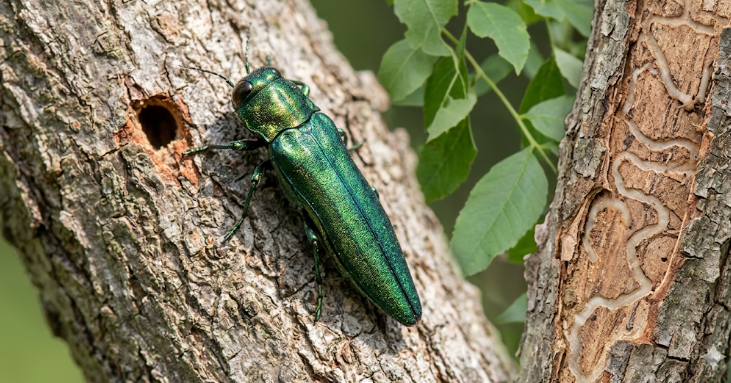
Adult Emerald Ash Borers emerge from the tree by chewing distinctive D-shaped holes about 1/8 inch wide.
In Wauwatosa, Bay View, and West Allis, these exit holes are often found:
- On the main trunk
- On larger branches
- On the sun-facing side of the tree
The flat edge of the “D” comes from the beetle’s body shape. These holes mean the insect has completed its life cycle inside your tree, which usually indicates an established infestation.
If you’re seeing multiple exit holes, the tree has likely been infested for at least 2–3 years.
3. Bark Splitting and Woodpecker Activity
As EAB larvae tunnel beneath the bark, the tree reacts by splitting and cracking along the grain. Over time, this damage becomes visible.
Common signs seen in Milwaukee ash trees include:
- Vertical bark splits
- Loose or falling bark revealing serpentine larval tunnels
- Increased woodpecker activity is stripping bark away
Woodpeckers are often the first “diagnosticians.” In Shorewood and Wauwatosa, sudden woodpecker damage on ash trees is often a stronger indicator than leaf loss. For detailed photos of these signs, you can refer to the University of Wisconsin-Madison Extension gallery.
Once bark begins peeling off, the tree is already in advanced decline.
Field Insight: Bay View Ash Tree Failure
Last summer, I inspected a large green ash in Bay View where the homeowner thought the tree just needed pruning. The canopy was thin, but still green. However, bark was splitting on the south side, and woodpecker damage was extensive.
A peel-back inspection revealed heavy larval tunneling throughout the trunk. We recommended removal within 30 days. Before the scheduled date, a mild thunderstorm caused the tree to snap halfway up the trunk, narrowly missing the garage. Ash trees killed by EAB become extremely brittle and can fail without warning, even in moderate wind.
Can an Ash Tree Be Saved?
Yes, but only if caught early.
Treatment works when:
- Less than 20–30% canopy decline
- Minimal bark splitting
- Few or no exit holes
Treatment fails when:
- More than 40% canopy loss
- Heavy woodpecker damage
- Visible trunk cracks or decay
Homeowners should review the UW-Madison Insecticide Guide to understand the costs and timing required for effective preservation. Once structural integrity is compromised, removal is the safest option, especially near homes, sidewalks, or power lines.
Frequently Asked Questions
How fast does Emerald Ash Borer kill a tree?
Emerald Ash Borer typically kills an ash tree within 2 to 5 years after infestation begins. Larger or stressed trees often decline faster.
All my neighbors’ ash trees are dying. Is mine next?
Very likely. Emerald Ash Borer spreads quickly and does not stop at property lines. If it’s in your area, your tree is at high risk.
Can a healthy-looking ash tree still be infested?
Yes. Many ash trees show no visible symptoms early on. Internal damage can progress for years before decline becomes obvious.
Is treatment expensive?
Preventative treatment costs significantly less than removing a large dead ash tree. Early action saves money and reduces risk.
Should I remove my ash tree before it dies?
In high-risk areas like Milwaukee, many homeowners choose removal once treatment is no longer effective or practical. Waiting increases cost and safety risks.
Are dead ash trees more dangerous than other dead trees?
Yes. Ash trees killed by Emerald Ash Borer become brittle quickly. They are known for sudden limb drop and structural failure, making them especially hazardous.
The Bottom Line
If you live in Milwaukee, WI, and have an ash tree, Emerald Ash Borer is not a possibility; it’s a probability. The key is timing. Catching the infestation early can save the tree, but once decline is visible, safety becomes the priority.
A Crawford Tree & Landscape can perform a timely inspection to determine whether treatment is still an option or if removal is the safest and most cost-effective decision.



 GreenSky® and GreenSky Patient Solutions® are loan program names for certain consumer credit plans extended by participating lenders to borrowers for the purchase of goods and/or services from participating merchants/providers. Participating lenders are federally insured, federal and state chartered financial institutions providing credit without regart to age, race, color, religion, national origin, gener or familial status. GreenSky® and GreenSky Patient Solutions® are registered trademarks of GreenSky, LLC. GreenSky Serviceing, LLC services the loans on behalf of participating lenders. NMLS 1416362. GreenSky, LLC and GreenSky Servicing, LLC are subsidiaries of Goldman Sachs Bank USA. Loans originated by Goldman Sachs are issued by Goldman Sachs Bank USA, Salt Lake City Branch.